
Last time was all about the stone. This time it’s the things you hit it with.
We spent a lot longer than planned reading about how sculptors actually work, and the short version is that nobody carves a statue with one chisel. There’s a proper order to it, and the game follows it pretty closely.
Rough, shape, refine, finish
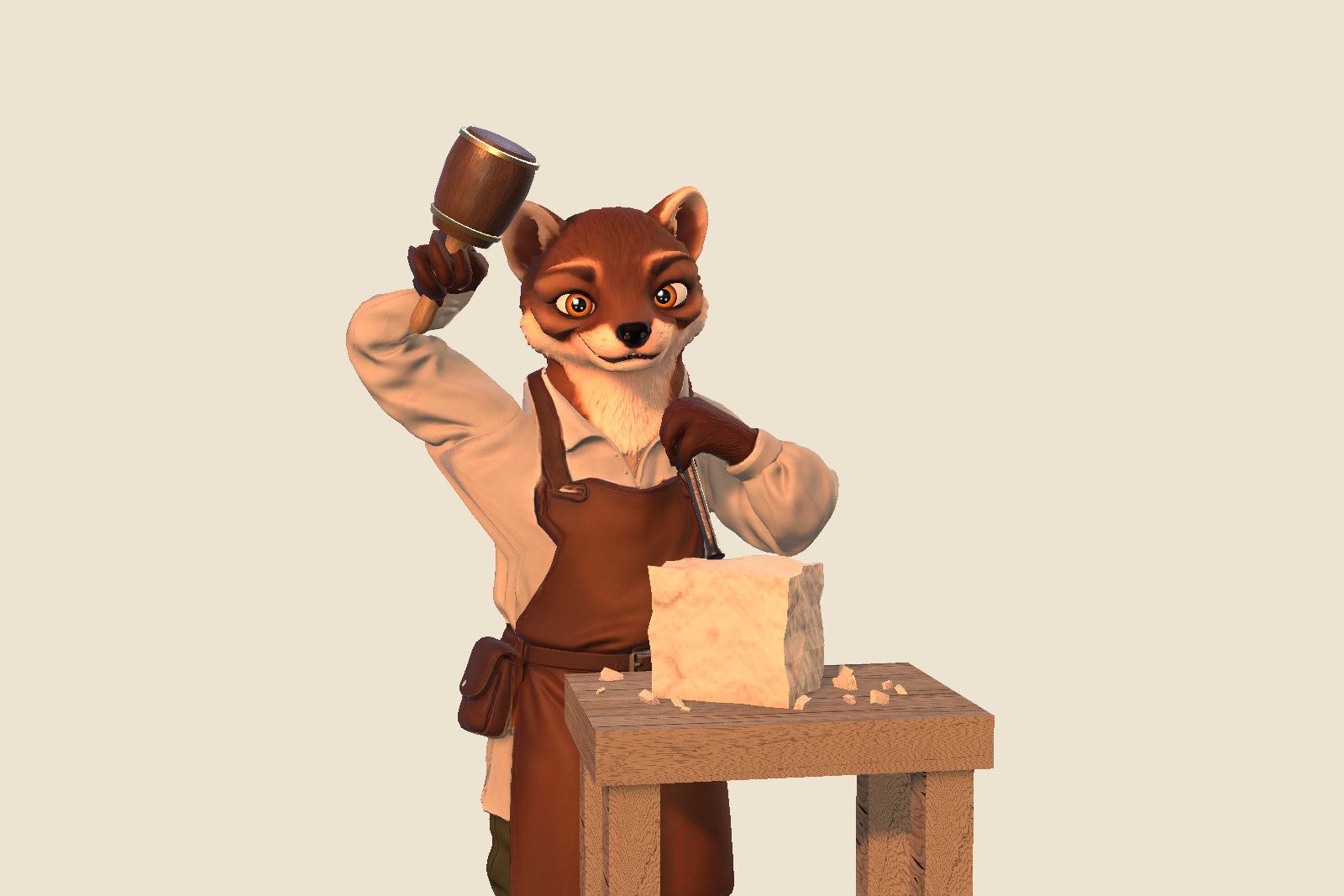
You start with the point chisel. It’s basically a steel spike, and it’s for knocking big lumps off quickly. It’s not subtle and it isn’t meant to be. Once the rough shape is there you move on to the claw (or tooth) chisel, which leaves those lovely ridged scratch marks, and the flat chisel for cleaning up planes and edges. After that come rasps and rifflers to smooth things out, and finally abrasives and a polishing pad to bring up the shine.
All in, there are seventeen tools at the moment. Six chisels (point, claw, flat, pitching, bolster and roundel), a rasp, a riffler and a stone file, a frame saw, a bow drill and a hand burr for the fiddly bits, a sanding disc and a polishing pad, and then the dust brush, bellows and cloth for cleaning up after yourself.
Yes, that’s a lot. No, you won’t have all of them on day one. More on that another time.
How hard, and at what angle
Two things matter on every strike.
The first is weight. There’s a little power meter that swings between light and heavy, and you pick your moment. A light tap takes off a sliver. A heavy blow takes a proper bite, and it’s also the quickest way to break something you didn’t mean to (that’s next month’s post).
The second is angle. Hold the chisel steep and it digs in and removes material fast. Lower it and it pares the surface away instead. Real carvers do this without thinking, and getting it to feel natural with a mouse took a lot of fiddling. We’re still not completely happy with it on a gamepad, honestly.
Rough, smooth, polished
Every bit of the surface remembers how it was last worked. Fresh chisel marks are rough. Go over them with a rasp and they turn smooth. Work them with the abrasives and they start to take a polish. The game tracks how much of the piece is at each stage, so a commission can ask for a “smooth” finish or a “polished” one, and you can see at a glance how far off you are.
Polishing is weirdly satisfying. It’s the least dramatic thing in the whole game, just slowly rubbing a pad over stone, and yet it’s the bit people keep doing for longer than they need to.
Tools wear out
Every strike takes a little life out of the tool. A blunt chisel still works, it’s just slower and less precise, and eventually it needs sorting out before it’s any use. At the moment that means a menu with a repair button, which is about as cosy as a tax return. Something better is going to have to happen there. We have ideas.