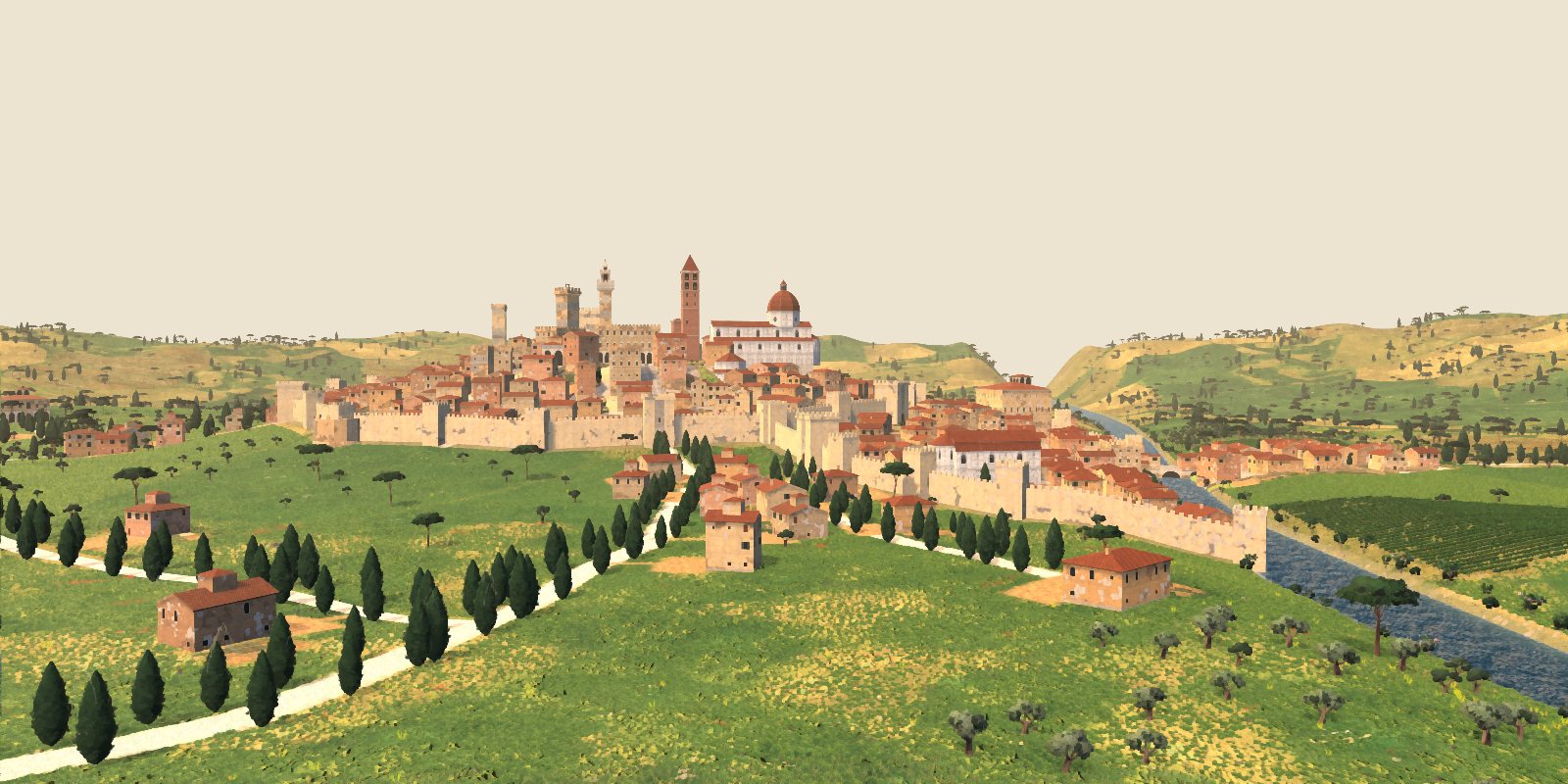
For months the “town” in this game was a list of buttons. Visit the stone yard. Visit the blacksmith. Return to the lab. It worked, but you never really felt like you were anywhere.
So, meet Collemarmo.
One town, many views
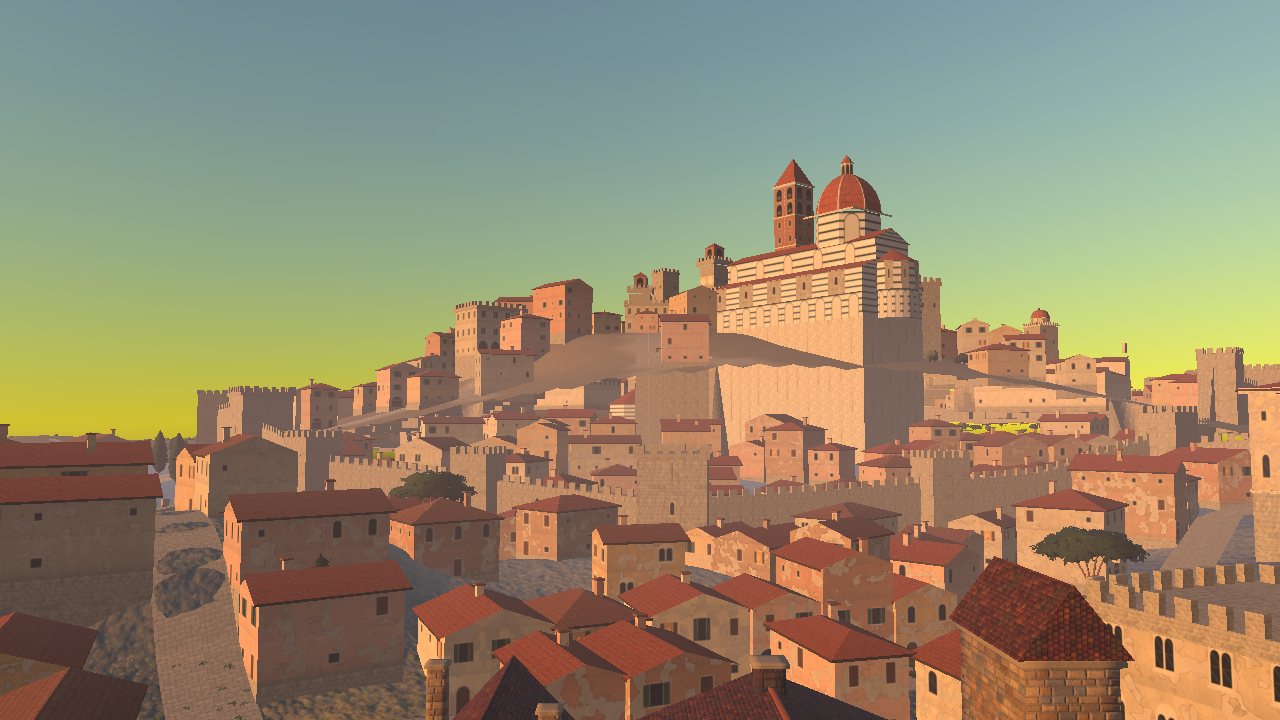
Collemarmo is a hill town with old walls at the top, a newer borgo spilling down towards the river, and a bridge with shops built along it at the narrowest point. Across the bridge is another little quarter, and up on the west side is a knoll where Matteo’s studio sits. In total it’s a little under 370 buildings and something like 1,400 trees, plus a quarry on the hill behind.
You don’t walk around all of it. Each place you visit is its own small scene: the studio, the stone yard, the forge, the shop. That keeps things light and lets each spot have its own lighting and mood. The trick is that every scene’s view of the rest of the town is built from one shared plan, a single file holding every street, wall, river bend and building. So the town you can see from the forge window is exactly the same town you can see from the quarry. Move a church in the plan, rebuild, and it moves everywhere.
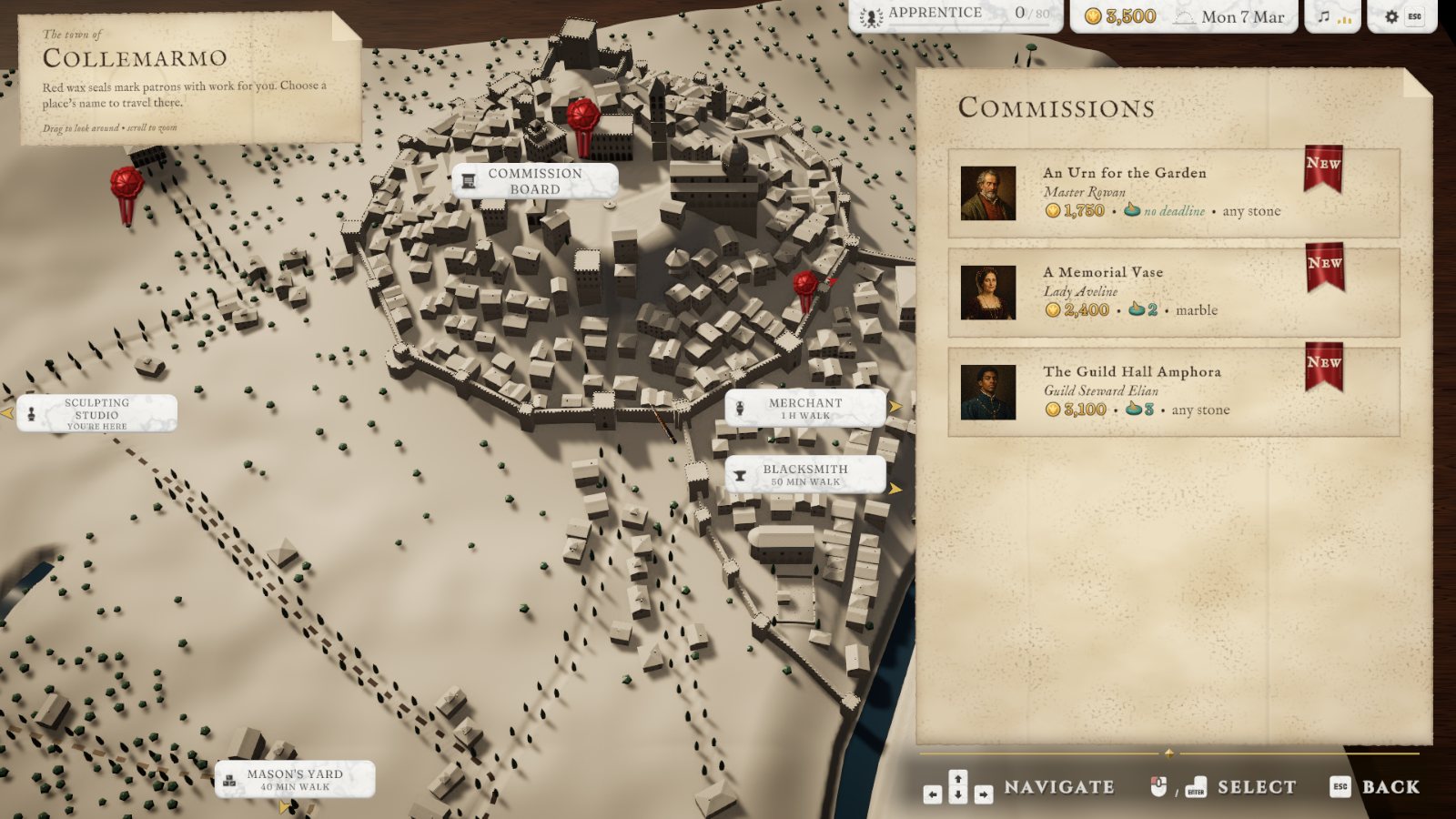
The map
To get around, you use a map. We wanted it to feel like something that would actually sit in a sculptor’s studio, so it’s a little carved marble model of the whole valley, at roughly 1:100 with the hills exaggerated a bit so they read. You can spin it, zoom in, and pick a place to go.
Open commissions show up on it as red wax seals, pinned over the house of whoever’s asking. So you can see that the gardener at the palace wants something, and the guild hall too, and decide which way to head.
Places
Il Poggio is the stone mason’s yard, on a loading terrace right at the mouth of the quarry, run by Mastro Sandro. There’s a derrick, a saw on trestles, blocks roped onto sledges and a view all the way across the meadow to town. Blocks that aren’t for sale are rough and chipped. The ones that are look a lot more tempting.
The Emporio sits at the end of the bridge. It’s a general store stuffed with jars, rugs, lamps, a lemon tree in a pot, and a cat asleep on the window seat (yes, another cat). It’s where studio upgrades will come from.
The forge is down in the borgo, by the river, with a waterwheel turning outside. This is where the boring repair button from the tools post went to die.
Sharpening your own chisels
Bruno the smith is busy. He’s got ploughshares and gates to finish and no time for some new sculptor nobody’s heard of. But his grindstone is free to use, so when your chisels go blunt you sharpen them yourself. Each repair is a little minigame (holding the edge at the right angle on the wheel without letting it overheat, for a chisel) and you’re graded on how well you did: Rough, Serviceable, Keen or Razor. Get a Razor and your tool gets a keen edge that Bruno’s own repairs can’t match.
Once you’ve made a bit of a name for yourself, Bruno will do it for you. He charges, mind. There’s also a quick option if minigames aren’t your thing.
Making a name
That “name for yourself” is prestige, and every finished commission adds to it. As it climbs you go from Apprentice to Established, Respected, Master and beyond, and each step opens something up: better stone at Il Poggio, finer tools at the forge, Bruno making time for you. Our hope is that it feels like the town slowly warming to you, rather than a number going up.
The church we had to fix
One last thing. The big domed church in the middle of town originally had black and white stripes all over it. There are real churches in Tuscany like that, but ours looked like a humbug. Seen from three different scenes, it was very hard to unsee. It now has inlaid marble panels, which look a great deal more believable. Sometimes “historically there’s a precedent” isn’t the same as “looks right”.